
Fire Resistant Cladding
If you are looking to install any type of cladding, including composite cladding, it is important to think about how
Products in Stock
Lowest Prices
Express Delivery
10-Year Warranty
March Sale. Up To 15% Off.
Composite decking is far more resistant to damp, rot, mould and warping than traditional timber decking, but it is still best to avoid standing water on your decking boards. Prolonged exposure to standing water can damage even composite decking boards over time. It can also present a slipping hazard and encourage mould and algae growth – again, this is something that composite boards are more resistant to than wooden boards, but they are not entirely immune.
Standing water may occur when decks are not built with a slight incline, but they could also be a sign of warping, damage or structural issues. This guide will look at the issues associated with standing water on decking and what you can do to prevent it.
Standing water refers to pools of water that remain on the deck rather than draining away after it has rained or the decking has been exposed to other sources of water such as spillages or water from a hose pipe.
Water should drain away from a properly installed and maintained deck, so it may be a sign that there is an issue with the drainage, structure or state of the boards themselves.
So, is standing water really bad for a deck? It certainly can be, especially if left for long periods. When looking at the pros and cons of composite vs wood decking, one of the main benefits of composite materials is that they are far more resistant to water damage. Boards and subframes can still deteriorate if left exposed, however, so it is always best to be cautious and prevent or get rid of standing water.
There are two main ways to prevent standing water from developing on decking. These are outlined below…
Building your decking on a slight decline or slope allows water to run off it. If the deck is located next to the home (or other structures such as sheds or outhouses), the decline should be away from the structure to help prevent further pooling and water damage.
The decline does not need to be very steep. A 1%-2% slope or a fall of around 1.5cm for every metre of length should be enough to effectively drain water without the deck feeling unbalanced when you use it.
You should also leave gaps in your composite decking. Gaps between boards let water drain through, but are also essential for preventing damage from the expansion and contraction that naturally occurs with changes in temperature and humidity. Slightly increasing these gaps can allow water to run through them more effectively, limiting standing water.
If you do find standing water, you can generally get rid of it quite easily. A mop and bucket can help mop up the excess water. Alternatively, a towel or soft bristled broom can be used to push the water off the deck. You should also pay attention to the cracks and gaps, getting the broom bristles into difficult-to-reach areas as mould may accumulate there.
You should always get rid of standing water when you notice it, but repeated instances could be a sign that your decking is sagging or warping and may need attention – especially if it is a new development.
When thinking about the question, ‘Why is standing water bad for a deck?’ you also need to consider the subframe. As with decking boards, prolonged exposure to water can cause joists and decking subframe components to deteriorate over time.
Proper ventilation and spacing of the boards will help prevent standing water from gathering under the deck, as it will be able to evaporate over time. Preventing or dealing with standing water on visible surfaces will also help.
During installation, you can use joist tape or waterproof coatings, but it’s also worth remembering that composite subframes and joists, such as decking boards, are more resistant to water damage, rot and mould than timber equivalents.
Proper installation of decking with an incline and adequate gaps between boards can help to combat this issue. If you do get standing water, it should be removed as soon as possible, but prevention is always better than having to apply a cure.
It can also help if you use composite decking, as our material is slip-resistant, easy to maintain, and far more resistant to mould, algae, warping and rotting when compared to traditional wooden decking. It also makes for a sturdy and water-resistant subframe. Explore our complete product range for a stylish, eco-friendly and extremely durable decking choice.
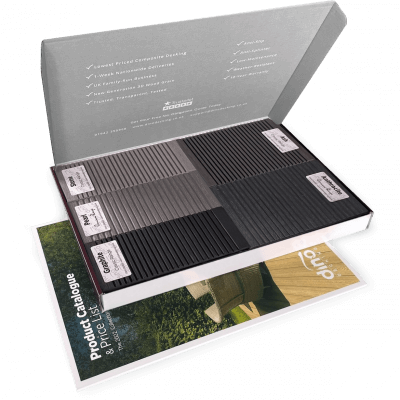
Our sample pack contains a sample piece of each colour currently available. Order your free sample pack today to compare the colours and get a true feeling of the Dino Decking range!
If you are looking to install any type of cladding, including composite cladding, it is important to think about how
You might love your garden, but are you really making the best use of it? Nobody uses their garden all